How to Get a Business Loan in Pakistan – Complete Guide for Small Businesses and SMEs
MyShopFront Editorial Team · Published 4 November 2026 · Last updated 4 November 2026
Short answer. To get a business loan in Pakistan, decide what the money is for, work out how much you need, compare lenders (banks, Islamic banks, microfinance institutions and government-supported schemes), check each lender's eligibility rules, prepare your documents, apply, and review the written terms before you accept. Requirements, amounts and pricing differ from lender to lender and change over time, so always confirm them on the lender's official page or at a branch.
Why Access to Business Financing Matters in Pakistan
Almost every small business hits the same wall: the orders, customers or ideas are there, but cash is tied up in stock, rent, wages and supplier credit. A business loan is one way to bridge that gap. It can pay for inventory before a busy season, a second machine, a better shop, or the working capital that lets you say yes to a bigger order.
This guide is written for shop owners, home-based sellers, retailers, startups and growing SMEs in Pakistan. It explains the process in plain language, compares the main types of financing, lists lenders whose own pages describe SME products, and is honest about what we could and could not verify. It is general information, not financial advice, and it never promises that any lender will approve your application.
How to read this guide. Boxes marked Verified summarise something we read on an official regulator, bank or government page on 4 November 2026. Boxes marked General guidance are widely applicable advice that is not tied to one lender. Rates, limits and schemes change, so use the links to confirm before you apply.
What counts as an SME in Pakistan?
The State Bank of Pakistan (SBP) classifies enterprises for regulatory purposes by annual sales turnover. In the SBP's SME Prudential Regulations (official PDF), a micro enterprise has sales up to PKR 30 million, a small enterprise above PKR 30 million up to PKR 400 million, and a medium enterprise above PKR 400 million up to PKR 2,000 million. The same document treats a micro, small or medium enterprise that is up to five years old as a start-up.
SBP SME definitions. Source: SBP, Prudential Regulations for Small & Medium Enterprises Financing (version dated July 2026), checked 4 November 2026. Lenders may apply their own internal criteria on top of the regulatory definition.
How to Get a Business Loan in Pakistan: Step by Step
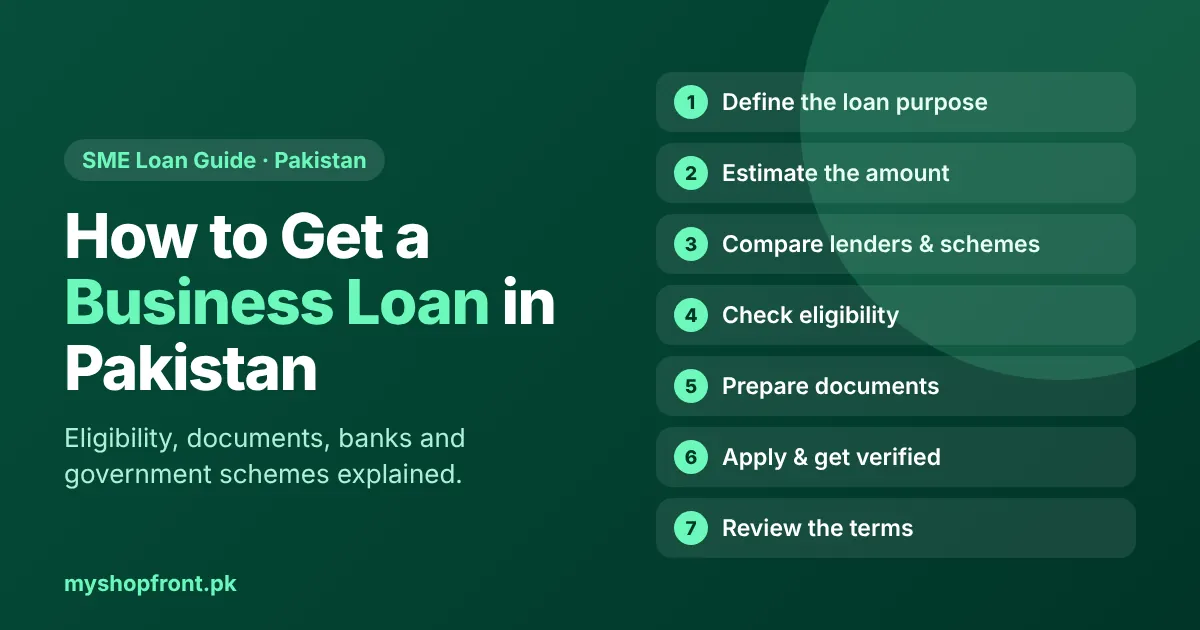
The exact paperwork varies, but almost every business loan in Pakistan follows the same eight steps. Work through them in order and you will avoid the most common reasons applications stall.
- Identify the purpose of the loan. Be specific: buying stock, paying for equipment, renovating premises, covering seasonal cash flow or starting a business. The purpose decides which product fits. A working-capital line and an equipment loan are priced, secured and repaid differently.
- Estimate the financing you need. Add up the real cost (quotations, supplier invoices, rent deposits) and subtract what you can contribute yourself. Borrowing a little more than you need costs money, and borrowing too little forces a second application. Check whether the repayments fit comfortably inside your monthly cash flow.
- Research banks and financing schemes. Compare more than one lender. The SMEDA SME Financing Portal describes itself as Pakistan's official SME financing portal and lets you filter products from 20+ banks by sector, purpose, loan range and bank. Also look at Islamic banks, microfinance institutions and any government-supported scheme that is currently open.
- Check the eligibility criteria. Read the product page carefully: minimum time in business, age limits for the owner, whether collateral is required, and whether your business type is covered. Several bank products described below ask for around three years in operation, so a very new business may need a different route.
- Prepare the required documents. Gather your CNIC, bank statements, proof of business address, sales records and, where the lender asks for it, tax and registration papers. SBP's regulations require banks to give applicants a list of the documents needed to process the application, so ask for it up front.
- Submit the application. Apply online if the lender offers it, or at a branch that handles SME business. SMEDA's portal notes that you can contact the bank's SME financing officer shown in each product's contact details.
- Complete the bank's verification. Expect an identity and credit-history check (SBP's regulations require a recent e-CIB or licensed credit-bureau report for credit proposals), a visit or other verification of your business, and valuation and legal checks if property is offered as security. SBP's regulations also allow digital onboarding, geo-tagged verification and video KYC.
- Review the financing terms before accepting. Read the offer letter: amount, tenor, how the profit or mark-up is calculated, processing and other charges, late-payment terms, and what happens if you repay early. SBP's regulations require loan terms to be disclosed in English and Urdu. Ask for anything you do not understand to be explained in writing.
how long should a bank take?. SBP's SME regulations say banks should process applications that come with complete KYC and relevant financial data within 15 working days. That is a regulatory processing target, not a guarantee of approval, and valuation, legal checks or missing documents can add time.
Types of Business Loans Available in Pakistan
Short answer: most small-business borrowing in Pakistan falls into working-capital finance (day-to-day cash flow) or term finance (a fixed amount repaid over time for equipment, premises or expansion). Islamic banks offer Shariah-compliant equivalents, microfinance institutions serve very small and informal businesses, and some government programmes subsidise financing for eligible groups.
| Type | What it is for | Typical security | Worth knowing |
|---|---|---|---|
| SME business financing | General business needs of small and medium firms: stock, receivables, premises, vehicles | Varies: property mortgage, hypothecation, personal guarantees | Governed by SBP's SME Prudential Regulations; terms differ by bank |
| Startup financing | A business up to 5 years old (SBP's start-up definition) | Often personal guarantees or a government guarantee scheme | Many bank products ask for around 3 years in operation, so check eligibility first |
| Working capital financing | Short-term cash flow: buying stock, paying suppliers, seasonal gaps | Often a running-finance line reviewed periodically | Usually priced on a benchmark rate such as KIBOR plus a spread |
| Business expansion loans | A second outlet, a bigger shop, new capacity | Property, equipment or stock | Lenders look at past cash flow, not only the plan |
| Equipment and machinery financing | Machines, tools, vehicles, solar or other fixed assets | The asset itself, plus guarantees | SBP-backed long-term financing facilities for plant and machinery are listed on SMEDA's portal |
| Microfinance business loans | Very small and often informal businesses, frequently women entrepreneurs | Group or personal guarantee, depending on the lender | Smaller amounts and shorter tenors; check the lender is regulated |
| Government-supported schemes | Eligible groups such as youth or specific sectors | Set by the scheme | Open and close; confirm current status on the official site |
| Islamic banking financing | Same business needs, structured as sale, lease or partnership contracts | Varies by contract | Interest-free in structure, but not free of cost; profit is built into the contract |
SME business financing
Banks offer SME products for owners who have been trading for some time and can show sales and bank activity. Examples from the banks' own pages are described in the next section, such as HBL Small Business Finance and the Bank Alfalah SME loans.
Startup financing
There is no single national startup loan. SBP's definition treats a business up to five years old as a start-up, but individual bank products set their own conditions, and several require around three years of operating history. Newer businesses commonly look at government-supported schemes, products aimed at SMEs without an existing bank relationship (such as the I-SAAF scheme described by Meezan Bank) and microfinance.
Working capital financing
Working-capital finance funds the gap between paying for stock or labour and getting paid. A running-finance facility works like a revolving limit: you draw and repay within an approved limit. HBL's page, for example, lists running finance priced as the 3-month average asking KIBOR plus an applicable spread.
Business expansion loans
These fund growth: new premises, renovation, extra capacity. Bank Alfalah's Milkiat Finance, for instance, is described on the bank's page as finance to buy, construct or renovate business premises.
Equipment and machinery financing
Term loans for assets are usually repaid over several years and secured against the asset. SMEDA's portal lists SBP schemes for plant and machinery and for SME modernisation. Rates under those schemes are set by SBP and the lending bank and change, so check the current figures before you rely on them.
Microfinance business loans
Microfinance institutions lend small amounts to micro-entrepreneurs, often those who are not served by commercial banks. Kashf Foundation, for example, is a women-focused microfinance institution, and its homepage says its lending decisions are based on an assessment of business flows, entrepreneurial capacity and household income.
Government-supported financing schemes
These are covered in their own section below, with a clear note on what we could and could not confirm.
Islamic banking business financing
Islamic banks structure finance as contracts such as Diminishing Musharakah, Bai Salam or leasing rather than a conventional interest-bearing loan. Meezan Bank's SME page lists working capital, import finance, export refinance, long-term finance, documentary credit and project financing. "Interest-free" here describes the contract structure; you still pay a profit or rental amount agreed in the contract.
Banks and Institutions Offering SME Financing in Pakistan
Short answer: many banks lend to SMEs. The cleanest way to compare them is SMEDA's official portal, which says it lets you search 115+ products from 20+ banks and apply directly with "no registration, no middlemen, no fees". Below are institutions whose own pages we were able to read on 4 November 2026. We describe only what those pages state and link to each one.
What we could not verify. The pages of some large lenders (for example UBL, National Bank of Pakistan and Bank of Punjab) did not return readable content to us, so we have not described their products. That is a gap in our checking, not a judgement about those banks. Use the SMEDA portal or the bank's branch to check them.
HBL (Habib Bank Limited): HBL Small Business Finance
Products.
- Running Finance, Demand Finance, Letters of Guarantee and Letters of Credit against mortgage of residential, commercial or industrial property.
- Facilities described as up to PKR 20 million secured by mortgage of acceptable real estate. Demand Finance up to 3 years; Letter of Credit up to 180 days.
- Pricing is stated as a benchmark KIBOR plus an applicable spread; no fixed rate is published on the page.
Eligibility.
- Sponsor, mortgagor and borrower must be resident Pakistanis aged 25 to 65.
- A business in operation for at least 3 years.
How to apply.
- Use the Apply Now button on the product page or visit your nearest branch.
- Documents listed include attested CNIC copies, application form, property title documents, NTN or trade-body certificate where applicable, rent agreement if premises are rented, a certified one-year bank statement, and a proprietorship letter, partnership deed or Form 29.
HBL Small Business Finance (official) · HBL SME finance application (official)
Meezan Bank: Islamic SME financing
Products.
- Shariah-compliant SME finance including Bai Salam, Diminishing Musharakah, letters of credit and guarantee, long-term finance for plant and machinery, and an Islamic export refinance scheme.
- The page describes I-SAAF (Islamic SME Asaan Finance), an SBP scheme for collateral-free financing up to PKR 10 million for SMEs without an existing relationship with Meezan Bank. Parts of the page refer to older dates, so confirm with the bank that it is currently offered.
Eligibility.
- For I-SAAF the page states that new and operating SMEs without an existing relationship with the bank can apply.
- Security varies case to case; the page mentions personal guarantees and, preferably, urban property.
How to apply.
- Visit a Meezan Bank branch that offers SME solutions. Documents listed for small enterprises include a company profile, financing request, accounts for the last three years, signed borrower fact sheet, CNIC copies, stock and receivables reports where relevant and the last six months of bank statements.
Meezan Bank SME Banking (official)
Bank Alfalah: SME loans
Products.
- Alfalah Karobaar Finance: running finance, guarantees and letters of credit against mortgage of property, for customers with a CNIC aged 23 to 60 and at least 3 years in business; limit up to 70% of assessed market value.
- Alfalah Merchant Line: for Bank Alfalah POS merchants with a year's history and at least PKR 1 million in annual POS sales; up to PKR 15 million for one year, renewable, with no collateral up to PKR 5 million.
- Alfalah Milkiat Finance: buy, build or renovate business premises, PKR 0.5 million to PKR 200 million over 2 to 15 years.
- Alfalah Quick Finance: running finance against securities such as NSCs, prize bonds, selected mutual funds or deposits, from PKR 50,000 to PKR 300 million, up to 90% of the security.
- Alfalah Fleet Finance: vehicle term loans over 1 to 5 years.
Eligibility.
- Each product page states its own age, time-in-business and security rules. Merchant Line is limited to the bank's POS merchants.
How to apply.
- Use Apply Now on the product page or apply at a branch. The bank's pages do not list documents for these products; SMEDA's portal shows document checklists.
Bank Alfalah SME loans (official) · Product details on SMEDA's portal
Bank AL Habib: SME banking
Products.
- The bank's website has a dedicated SME banking section. We could confirm the section exists but did not read its product terms.
Eligibility.
- See the bank's page.
How to apply.
- Follow the bank's website or visit a branch.
Bank AL Habib SME banking (official)
Kashf Foundation: women-focused microfinance
Products.
- Kashf is a women-focused microfinance institution in Pakistan. Its homepage does not list amounts, rates or documents.
Eligibility.
- Its homepage says lending decisions are based on business flows, entrepreneurial capacity and household income.
How to apply.
- See the financial services pages on its website or contact it using the details published there.
SMEDA SME Financing Portal (directory, not a lender)
Products.
- A government-run directory of bank SME products. It also lists SBP schemes such as a Credit Guarantee Scheme for Small and Rural Enterprises, a Refinancing Scheme for Modernization of SMEs, a Long-Term Financing Facility for Plant & Machinery, and export finance schemes.
- The portal includes an EMI calculator and an eligibility quiz. Its sample figures are illustrations, not offers.
Eligibility.
- Each product card shows eligibility, documents, mark-up, tenure and collateral.
How to apply.
- Compare products, then contact the bank's SME officer named in the product's contact tab.
SMEDA SME Financing Portal (official)
General guidance: compare before you apply. Rates and fees are deliberately not quoted here because they change and depend on your profile. Ask each lender for the total cost of financing (mark-up or profit, processing fees, valuation and legal charges, insurance and late-payment terms), not just the headline rate.
Government Business Loan Schemes in Pakistan
Short answer: the main federal programme for youth business financing is the Prime Minister's Youth Programme (PMYP) loan scheme, now called the PM Youth Business & Agriculture Loan Scheme and earlier branded Kamyab Jawan. Its terms (amounts, mark-up, age limits, banks taking part) have changed between rounds, and we could not read the official application portal, so we do not print figures for it. Confirm everything on the official site before you apply.
| Scheme | Status as far as we could verify | Where to confirm |
|---|---|---|
| PM Youth Business & Agriculture Loan Scheme (earlier called Kamyab Jawan) | The official PMYP site is live and lists loan applications. HBL's SME menu also lists the scheme. We could not read the loan portal itself, so we cannot confirm whether a round is open today. | pmyp.gov.pk |
| SBP SME refinancing and guarantee schemes | Listed on SMEDA's official portal (for example a credit guarantee scheme for small and rural enterprises and a modernisation refinancing scheme). Rates and limits are set by SBP and change. | SMEDA portal |
| Provincial and sector programmes | These open and close often. We did not find an official page we could read, so we do not list individual provincial schemes. | Your provincial government's official website |
Who can apply, and for what?
Government-supported schemes target specific groups, such as young entrepreneurs, or specific purposes, such as agriculture or machinery. Eligibility, required documents and the application route are defined by each scheme and implemented through participating banks, so the safest source is the scheme's official page or the bank's scheme page. HBL, for example, lists the PM's Youth Business & Agriculture Loan Scheme among its SME products.
How to apply
- Open the official PMYP site at pmyp.gov.pk and follow its loan section.
- Read the current eligibility rules, loan categories and the list of participating banks on that page.
- Prepare your CNIC, business details and any documents the scheme lists, then submit through the official channel.
- Be careful with look-alike websites and agents who ask for fees: use only the official government address and the participating bank's own channels.
Active versus discontinued. Schemes are sometimes paused, renamed or closed. Several blog posts online describe loan tiers and mark-up rates for the PM scheme with confidence, but we could not match them to an official page, so we have left them out. If a page cannot show you the date it was last updated and an official source, treat its numbers as unconfirmed.
Eligibility Criteria for SME Business Loans
Short answer: lenders mainly want to know that you are who you say you are, that your business is real and earning, and that you can repay. The details differ by institution and product, so use this as a checklist, not a guarantee.
- Pakistani citizenship or eligible ownership. Bank pages commonly ask for a CNIC and, in some cases, that borrowers are resident Pakistanis within a stated age range (HBL's page, for example, states 25 to 65 for its Small Business Finance).
- Business registration, where applicable. Documents listed by lenders include a proprietorship letter, partnership deed or company registration papers depending on how the business is organised.
- Operating history. Several bank products ask for about three years in business. Government-supported schemes and some SBP-backed products are the usual routes for newer businesses.
- Business income and cash flow. Lenders check that your earnings can cover repayments, usually from sales records and bank statements.
- Bank account and transaction history. Many lenders ask for 6 to 12 months of statements; Meezan's page lists six months and HBL's lists a certified one-year statement.
- Credit history. SBP's regulations require a recent e-CIB or credit-bureau report for credit proposals, so past defaults and overdue payments matter.
- Business plan or financial projections. Especially for term loans, new ventures and larger amounts.
General guidance. Requirements differ between institutions and between products at the same institution. A request that one bank declines may fit another bank's product, so ask the lender which product matches your situation.
Documents Required for a Business Loan in Pakistan
Short answer: expect to provide your CNIC, bank statements, proof of the business and its address, and records of sales. SBP's regulations require banks to give applicants the list of documents needed, so ask for the exact list for your product. The following are the documents commonly named on bank pages.
- CNIC (attested copies for owners, partners, directors and guarantors).
- Business registration documents, if applicable: proprietorship letter, partnership deed, or company registration papers.
- Bank statements: commonly six months to one year, sometimes certified by the branch.
- Business financial statements: accounts for recent years for larger amounts, or a simple profit-and-loss summary for small ones.
- Tax registration or returns, where required: for example an NTN or a trade-body certificate.
- Business plan or projections, particularly for startups, expansion and long-term loans.
- Proof of business address: rent agreement, ownership documents and a recent utility bill.
- Sales and revenue records: invoices, ledgers, order histories or point-of-sale reports.
- Anything else the lender asks for: property documents for secured loans, passport photographs, or supplier quotations for equipment.
HBL's document list. HBL's Small Business Finance page lists attested CNIC copies, a prescribed application form, title documents and property tax receipts for security, NTN or trade-body certificate if applicable, rent agreement if premises are rented, two passport photographs, last paid utility bill, a certified one-year bank statement, and a proprietorship letter, partnership deed or latest Form 29 or search report.
Can I Get a Business Loan Without Business Registration?
Short answer: sometimes, but options are narrower and approval is never guaranteed. Formal bank products ask you to prove that a business exists. For a sole proprietor that can be a proprietorship letter rather than a company registration, and tax registration is requested "if applicable" on at least one major bank's page.
- Sole proprietors and small retailers: may be able to apply with a proprietorship letter, CNIC, shop rent agreement or ownership proof, utility bill and bank statements.
- Home-based and informal businesses: microfinance institutions and some government-supported schemes are generally better fits than commercial SME products, because they assess business flows and household income rather than registration alone.
- Freelancers and online sellers: lenders will look for consistent income. Regular deposits into a bank account and organised sales records help.
- Limits to expect: smaller amounts, shorter terms, personal guarantees and more questions about how the business operates.
General guidance. Registering with the right authority (for example FBR for an NTN, or SECP for a company) can open more products and larger limits. Check the official sites of FBR and SECP for current procedures. Registration does not guarantee approval either.
How to Improve Your Chances of Getting a Business Loan
Nothing here guarantees approval, but each habit makes your business easier for a lender to assess.
- Keep financial records. A simple monthly record of sales, costs and profit shows repayment capacity better than verbal claims.
- Separate personal and business money. Use a dedicated business account so statements reflect the business's real activity.
- Prepare a realistic business plan. State what you will buy, what it will earn and how you will repay. Use conservative numbers.
- Maintain a healthy bank transaction history. Regular deposits and avoiding frequent overdrafts or bounced cheques help.
- Demonstrate repayment capacity. Show that your monthly profit comfortably covers the instalment, with a buffer for slow months.
- Check your credit record early. Clear overdue amounts and correct mistakes before you apply.
- Apply for what you can afford. A modest, well-justified request is easier to approve than a large, vague one.
- Keep proof of your online and offline sales. Order histories from your online store, courier reports and mobile-wallet statements are records of real sales you can show if a lender asks.
Frequently Asked Questions
How can I get a loan for my business in Pakistan?
Decide what the money is for and how much you need, compare lenders (banks, Islamic banks, microfinance institutions and government schemes) using a source such as SMEDA's SME Financing Portal, check each product's eligibility, prepare your CNIC, bank statements and business records, apply, and review the written terms before accepting. Approval is at the lender's discretion.
Which bank gives easy business loans in Pakistan?
No bank is "easiest" for everyone, and we do not rank them. Ease depends on your business age, records and security. Examples from banks' own pages include Bank Alfalah's Merchant Line for its POS merchants (no collateral up to PKR 5 million) and the I-SAAF scheme described by Meezan Bank for SMEs without an existing relationship with the bank. Compare products on SMEDA's portal and confirm availability with the bank.
Are there SME business loans available in Pakistan?
Yes. SBP regulates SME financing through its SME Prudential Regulations, and SMEDA's portal says it lists 115+ products from 20+ banks. Banks such as HBL, Meezan Bank and Bank Alfalah describe SME products on their own websites.
Can I get a business loan without collateral?
Sometimes. SBP's regulations allow banks to extend clean (unsecured, personal-guarantee-only) exposure to an SME of up to PKR 50 million, and some products, such as Bank Alfalah's Merchant Line (up to PKR 5 million) and the I-SAAF scheme (up to PKR 10 million), are described as collateral-free. Other products, such as HBL Small Business Finance, are secured by property. Each lender decides.
Can I get a loan for a new startup?
It is harder but possible. SBP treats a business up to five years old as a start-up, but several bank products ask for around three years in operation. New businesses often look at government-supported schemes, SBP-backed products for SMEs, and microfinance. Check each lender's eligibility rules.
What is the minimum business loan amount in Pakistan?
There is no single national minimum. It depends on the lender and product. For example, Bank Alfalah's Quick Finance starts at PKR 50,000 and its Milkiat Finance at PKR 0.5 million. Microfinance institutions lend smaller amounts; ask them directly.
How much business loan can I get in Pakistan?
It depends on your business, cash flow, security and the product. HBL's Small Business Finance describes facilities up to PKR 20 million secured by property, and Bank Alfalah's Karobaar Finance sets limits up to 70% of assessed property value and three times turnover. SBP's regulations also set exposure ceilings per borrower (PKR 100 million for micro and small enterprises and PKR 500 million for medium enterprises).
What documents are required for an SME loan?
Commonly a CNIC, bank statements, proof of business and address, sales records, tax registration where applicable, business plan and any property documents for secured loans. The exact list is set by the lender, and SBP's regulations require banks to give you that list.
Can a home-based business get a business loan?
Possibly. Commercial bank products usually want proof of a business and some operating history. Microfinance institutions and some government-supported schemes are generally a closer match for home-based businesses. Organised records of sales and bank deposits help.
Are interest-free business loans available in Pakistan?
Islamic banks offer Shariah-compliant financing that does not use interest, but it is not free: you pay a profit or rental amount agreed in the contract. Truly zero-mark-up programmes have been offered through some government schemes and charitable lenders, but availability changes, and we could not verify a current one from an official page. Check the official source before you apply.
How long does business loan approval take?
It varies. SBP's regulations say banks should process applications with complete KYC and financial data within 15 working days. Property valuation, legal checks and missing documents can extend that. Ask your lender for an expected timeline in writing.
Build Your Online Business Before Applying for Financing
A lender wants to see a real, organised business. A professional online store will not guarantee a loan, and no tool can, but it can make your business easier to run and easier to show. With MyShopFront you can:
- Showcase your products professionally with photos, prices and descriptions in one place.
- Reach customers beyond your local area with a store link you can share on WhatsApp, Instagram and Facebook.
- Receive and manage online orders in one dashboard instead of scattered chats.
- Present your business more professionally to customers and partners.
- Keep better visibility of your business activity, orders and sales over time.
MyShopFront is not a lender and does not arrange loans. Having an online store does not guarantee that any lender will approve an application.
Sources
- State Bank of Pakistan: Prudential Regulations for SME Financing (PDF)
- SMEDA SME Financing Portal
- HBL Small Business Finance
- Meezan Bank SME Banking
- Bank Alfalah SME Loans
- Bank AL Habib SME Banking
- Kashf Foundation
- Prime Minister's Youth Programme (PMYP)
- State Bank of Pakistan
Written and reviewed by the MyShopFront Editorial Team. Facts about lenders and regulators were read from the official pages linked in the text and in the sources list on 4 November 2026. We do not accept payment to feature a lender. This article is general information, not financial or legal advice. Rates, limits and schemes change; confirm with the lender before you apply.
MyShopFront home · Blog · how to get more orders for your shop · pricing · create a free online store in Pakistan