How to Start Dropshipping in Pakistan – Step-by-Step Guide for Beginners
MyShopFront Editorial Team · Published 5 November 2026 · Last updated 5 November 2026
Short answer. To start dropshipping in Pakistan, register your business and get an NTN, choose a niche, find a reliable supplier who ships to your customers, set prices that cover product cost, delivery and returns, open an online store or sales page, take orders on WhatsApp and social media, and send each order to the supplier to ship by a cash-on-delivery courier. You never hold stock, but you are still responsible to your customer for quality, delivery time and returns.
What Is Dropshipping and How Does It Work in Pakistan?
Dropshipping is a way of selling products online without keeping stock. You list a product in your store or share it on WhatsApp, Instagram or Facebook. When a customer orders, you pass the order and the customer's delivery details to your supplier, and the supplier packs and ships it. You keep the difference between what the customer pays you and what you pay the supplier.
In Pakistan most customers still prefer to pay when the parcel arrives, so a typical dropshipping order looks like this:
- The customer orders. They message you on WhatsApp or place an order on your online store, and you confirm the price, delivery charges and address.
- You confirm with the supplier. You send the order to your supplier and check the item is in stock before you promise a delivery time.
- The supplier ships by courier. The supplier hands the parcel to a courier with the customer's address and the cash-on-delivery amount.
- The customer pays on delivery. The courier collects the cash, and the money is passed back through the supplier or to you, depending on your agreement.
- You keep the margin. You pay the supplier their price and delivery cost; what is left is your profit, before tax and any returns.
The attraction is a low starting cost, because you do not buy stock up front. The catch is that you depend on someone else for quality and speed, while the customer blames you when something goes wrong. Most of this guide is about managing that risk.
How to read this guide. Boxes marked Verified summarise something we read on an official, courier or marketplace page on 5 November 2026. Boxes marked General guidance are widely applicable practice, not guarantees. We do not promise any level of profit: results depend on your product, price, marketing and customer service.
Is Dropshipping Legal in Pakistan? Registration and Tax Basics
Yes. Dropshipping is an ordinary way of running an online retail business, and we found no law written specifically for it. A Pakistani marketplace's guide to dropshipping states that dropshipping as a business model is legal in Pakistan, while advising sellers to register their business and file taxes correctly. What matters is that you run it like any other business.
Register your business
The simplest legal form for one person is a sole proprietorship; a private limited company suits teams and bigger plans. Business registration is handled by the Securities and Exchange Commission of Pakistan (SECP), and tax registration by the Federal Board of Revenue (FBR), which issues your National Tax Number (NTN). Ask a tax professional which route fits you, because the right form depends on your plans.
Get an NTN before you sell at scale
FBR rules for online sellers. ProPakistani reported in September 2025 that, from 1 July 2025, FBR directed online marketplaces and courier services not to serve unregistered sellers, and that sellers on marketplaces or their own e-stores must hold an NTN. It also reported a 1% withholding tax on digital payments collected by payment intermediaries and a 2% withholding tax collected by couriers on the gross amount of cash-on-delivery receipts, described as final tax on local e-commerce income. Source: ProPakistani, read 5 November 2026. We did not read the circular itself, and rules change, so confirm the current position on FBR's website or with a tax adviser before you rely on these figures.
In practice this means couriers may refuse to book parcels for sellers without an NTN, so registering early avoids a stalled business later.
What you must not sell
- Counterfeit or "first copy" branded goods, and anything that uses someone else's brand or trademark without permission.
- Weapons, ammunition, drugs and other banned or hazardous goods.
- Products that need an import licence or have customs duties if they come from abroad: check with Pakistan Customs before importing.
Not legal or tax advice. This section is general information, written from public pages on 5 November 2026. Requirements differ by business type and income. Speak to a registered tax consultant or lawyer before you start.
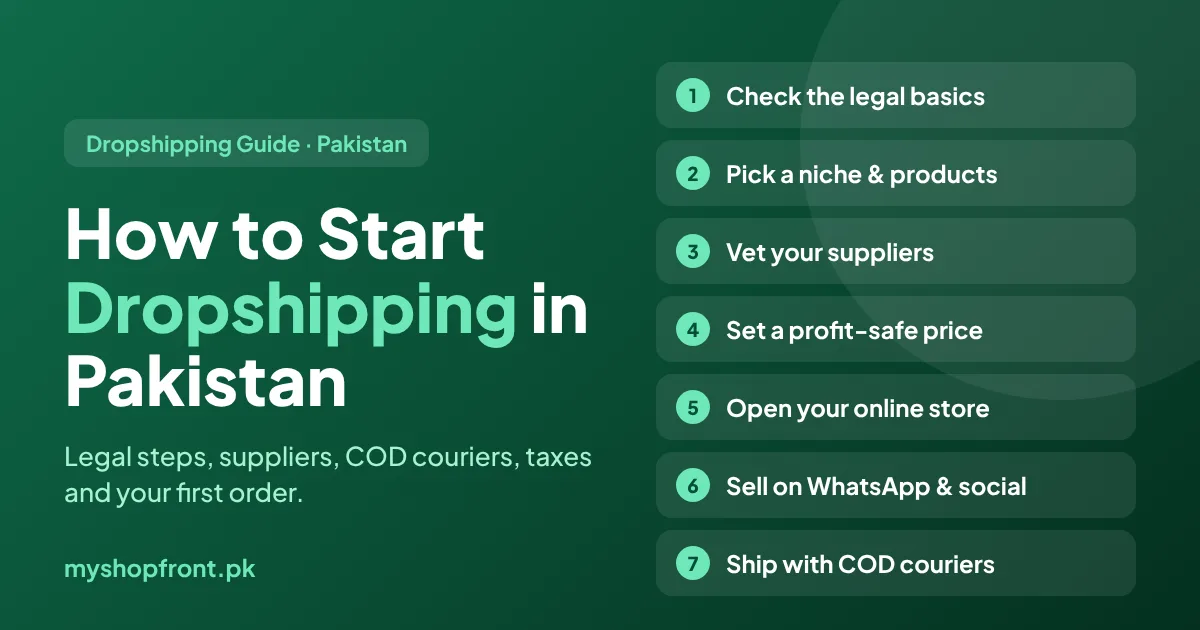
How to Start Dropshipping in Pakistan: 8 Steps
Work through these in order. The first four cost very little and protect you from the most common beginner mistakes.
- Choose a niche you can explain. Pick a category you understand and that people buy repeatedly, such as kitchen items, mobile accessories, kids' products or home organisers. A focused niche is easier to market than a store that sells everything.
- Check demand before you commit. Look at what sells on Daraz, Instagram pages and Facebook groups in your niche, and ask what customers complain about. Avoid products with a high return rate, such as fragile items and clothing with hard-to-guess sizes.
- Find and test suppliers. Shortlist two or three suppliers per product. Order a sample to your own address so you see the packaging, quality and delivery time the way your customer will.
- Work out your profit per order. Add product cost, courier charges, packaging, any payment fees, returns and tax, then price so that you still earn after all of them. See the pricing section below.
- Register and sort your payments. Register your business, get an NTN and open a business or personal bank account you can show to couriers. Decide how you will receive COD money and online payments.
- Open your online store. Create a store with clear photos, prices, delivery charges and a return policy. A store link you can share on WhatsApp, Instagram and Facebook looks far more trustworthy than screenshots in a chat.
- Get your first orders. Post your products, run a small test advertisement, and offer to answer questions on WhatsApp. Start with a handful of products rather than hundreds.
- Fulfil, collect feedback and improve. Track every parcel, message customers when it ships, and note delays and returns by supplier. Drop suppliers who let customers down.
Dropshipping Models: Local Suppliers, Marketplaces or Imports
There are three common ways to source products. Beginners in Pakistan usually do best starting with local suppliers because delivery is fast and returns are manageable.
| Model | How it works | Advantages | Watch out for |
|---|---|---|---|
| Local wholesalers and suppliers | A supplier in Pakistan ships to your customer by courier and you pay them after the sale or in advance | Fast delivery, COD works, easier returns and communication in Urdu | Quality varies, stock can run out, and some suppliers ask for advance payment |
| Reseller platforms and marketplaces | A platform lists products and handles fulfilment for resellers | Ready product catalogues and less supplier hunting | Fees and rules differ, and you depend on the platform's own terms |
| Importing from abroad | Products ship from an overseas supplier to the customer in Pakistan | Wider choice of products | Long delivery times, customs duties, payment difficulty and few options for refunds |
Whichever you choose, read the supplier's terms on returns, who pays for return parcels, and how long they take to dispatch an order.
How to Find and Vet Dropshipping Suppliers in Pakistan
Your supplier decides your reputation. Before you list a product, ask these questions and keep the answers in writing, for example in a WhatsApp chat:
- Stock: can they confirm availability the same day, and will they warn you before something sells out?
- Dispatch time: how many hours or days between your order and the courier pick-up?
- Packaging: is it unbranded and plain, with no price or supplier name on the parcel?
- Returns: who pays for the return courier, and do they refund you for damaged or wrong items?
- Payment terms: when do you pay, and how is COD money handled?
- Photos and descriptions: can you use their images, and do they match the real product?
Always order a sample. Buying one item yourself is the cheapest way to catch poor quality, slow delivery and misleading photos before a customer does. Re-order a sample from time to time to check quality has not slipped.
Where to look: local wholesale markets and their online pages, reseller platforms, supplier groups on Facebook and WhatsApp, and direct enquiries to manufacturers. Be careful with anyone who asks for a large advance payment before you have made a sale.
How to Price Your Products and Protect Your Profit
A price that looks profitable on paper can lose money once delivery, returns and tax are counted. Work out profit per order like this:
- Start with the price the customer pays you.
- Subtract the supplier's price for the product.
- Subtract delivery and packaging charges you pay.
- Subtract withholding tax or other taxes that apply to you, payment fees and advertising cost per order.
- Allow for a share of orders that are returned or refused at the door.
A worked example (illustrative numbers only). Suppose you sell a kitchen organiser for Rs. 2,000. The supplier charges Rs. 1,100 and delivery costs Rs. 250. Before tax, returns and advertising you keep Rs. 650. If advertising costs Rs. 300 per order and one parcel in ten is returned, the real profit per order is much lower than Rs. 650. These numbers are made up to show the method; use your own.
Our free guide to getting more orders explains a simple pricing rule that helps small sellers keep a healthy margin. Do not compete only on the lowest price: customers choose sellers they trust, and a fair price with fast replies beats a rock-bottom price with silence.
Cash on Delivery, Couriers and Getting Paid
Cash on delivery is how most online orders in Pakistan are paid, so your courier and supplier agreement matters as much as your product. Two couriers describe their COD services on their own pages:
| Courier | What its page says | Worth knowing |
|---|---|---|
| Leopards Courier | Offers a COD Retail service for low-volume sellers, registered with a CNIC copy and a shipment at a Retail Express centre; says payments are disbursed weekly to your bank account after delivery and that there is no minimum number of monthly shipments | Check the current service charges directly: the page does not state a rate |
| BlueEx | Describes a COD network of more than 600 delivery locations, 3 delivery attempts per shipment, an open-box delivery option and plugins for platforms such as Shopify | Its page lists some areas where it asked sellers to pause orders and states an average return ratio of 10%, which is the courier's own claim |
We list these as examples, not recommendations: other couriers also serve online sellers. Compare rates, delivery times, COD payout days and coverage for the cities where your customers live.
Reduce refused and returned parcels
- Confirm every order by WhatsApp or phone call before dispatch, repeating the product, total price and address.
- State delivery charges and the delivery time on your store so the total at the door is no surprise.
- Use clear photos and honest descriptions so the product matches expectations.
- Keep a record of customers who refuse parcels repeatedly.
You can also offer bank transfer, Easypaisa or JazzCash for customers who prefer to pay in advance; this removes COD refusals and speeds up your cash.
How to Get Your First Dropshipping Orders in Pakistan
Most first orders come from the people already in your network and from a few focused channels:
- WhatsApp: share your store link in your status and groups you belong to, and keep a WhatsApp number for orders. It is where many Pakistani customers prefer to ask questions.
- Instagram and Facebook: post short videos or photos showing the product in use, and answer comments quickly. Small test ads on a few products tell you what sells before you spend big.
- A store link customers can trust: a store with prices, delivery information and a return policy looks more professional than screenshots in a chat.
- Customer reviews: ask happy customers for a message or photo and, with their permission, show it. Never invent reviews.
Read our guide on how to get more orders for your shop for the first-order checklist and advertising basics.
Common Dropshipping Mistakes and Risks to Avoid
- Selling before testing the product. A customer's bad experience becomes your bad review.
- Promising delivery times you do not control. Ask the supplier, then add a safety margin.
- Ignoring tax and registration. Couriers and marketplaces may stop serving unregistered sellers, as described above.
- Listing counterfeit or branded copies. It risks takedowns and legal trouble.
- Having only one supplier. Keep a backup for each product.
- Too many products too early. Learn with a few before you expand.
- No return policy. Customers hesitate to order from sellers with no clear policy.
- Promising income. Be sceptical of courses that guarantee earnings; no one can promise results for a business model that depends on your effort and market.
Frequently Asked Questions
Is dropshipping legal in Pakistan?
Yes. We found no law written specifically for dropshipping, and it is treated as an ordinary online retail business. You should register your business, obtain an NTN from FBR and file taxes. A tax adviser can tell you which registration suits you.
How do I start dropshipping in Pakistan with no investment?
You do not need to buy stock, but you will still have small costs: registration, a phone or WhatsApp number, product samples, an online store and advertising. Start with a few products, test them, and reinvest early profits. Be wary of any promise of a business with literally zero cost.
Do I need an NTN to do dropshipping in Pakistan?
As reported by ProPakistani, FBR directed marketplaces and couriers from 1 July 2025 not to serve unregistered sellers and said sellers need an NTN. Check the current position with FBR or a tax adviser.
Can I do dropshipping with cash on delivery?
Yes, and most Pakistani customers expect it. Your supplier hands the parcel to a courier that collects cash on delivery. Confirm each order before dispatch to cut refusals, and agree in writing how COD money is passed back to you.
Which is better: local suppliers or importing?
Beginners usually find local suppliers easier: delivery is quicker, COD works and returns are simpler. Importing offers more choice but involves long delivery times, customs duties and payment difficulty.
How do I find dropshipping suppliers in Pakistan?
Look at local wholesale markets and their online pages, reseller platforms, supplier groups and manufacturers. Order a sample, ask about dispatch time, returns and COD payout, and avoid anyone demanding large advance payments before you have sold anything.
Which products are best for dropshipping in Pakistan?
Light, durable items that people reorder or gift, such as kitchen and home items or accessories, tend to be easier than fragile products or clothing with sizing problems. Test with a few and watch your returns.
Do I need a website to start dropshipping?
Not strictly: many sellers begin on WhatsApp and Instagram. But an online store with prices, delivery information and a return policy makes your business look more trustworthy and keeps orders organised. MyShopFront has a free Starter plan for up to 5 products.
How much money can I make from dropshipping in Pakistan?
No one can promise a figure. Your profit depends on product margin, advertising cost, return rates, tax and how well you serve customers. Calculate profit per order before you scale.
Can I sell on Daraz and my own store at the same time?
Many sellers do, but each marketplace has its own seller rules, fees and registration requirements. Read Daraz's current seller terms before you list. An own store gives you your own customer relationship and lets you share a link on WhatsApp and social media.
Open Your Dropshipping Store in Minutes
Once you have a supplier and a product, you need a place to show it and take orders. MyShopFront gives you an online store for your Pakistani business. Please note that MyShopFront is not a supplier and does not ship products; you pass each order to your own supplier. With MyShopFront you can:
- Create a store with your products, prices, photos and descriptions: the free Starter plan lists up to 5 products.
- Share your store link on WhatsApp, Instagram and Facebook.
- Receive orders in one dashboard instead of scattered chats.
- Set your delivery charges and payment options for your customers.
- Manage order status and customer details from your phone.
MyShopFront does not guarantee sales or profit. Dropshipping results depend on your product, price, suppliers and marketing.
Sources
- Federal Board of Revenue (FBR): NTN and tax registration
- Securities and Exchange Commission of Pakistan (SECP): business registration
- ProPakistani: FBR bars online marketplaces and couriers from serving unregistered sellers
- Leopards Courier: COD service
- BlueEx: COD service
- Markaz: Dropshipping legal requirements in Pakistan
- Pakistan Customs
Written and reviewed by the MyShopFront Editorial Team. Facts about regulators and couriers were read from the pages linked in the text and in the sources list on 5 November 2026. We do not accept payment to feature a courier or supplier. This article is general information, not legal, tax or financial advice. Rules, rates and courier terms change: confirm them with the source before you rely on them.
MyShopFront home · Blog · how to get more orders for your shop · free online store in Pakistan · how to get a business loan in Pakistan · pricing